If you’ve spent any time in mom groups lately, you’ve probably seen saffron come up. Someone’s child is melting down every afternoon, can’t sit still for homework, or lies awake for an hour after lights out, and someone else chimes in: “Have you tried saffron?”
And if you’re like me, your first thought was probably, the spice? The one I use in my yellow rice? Yes, that one.
I’ve gotten more questions about saffron for kids in the last few months than almost anything else, and after using it myself with great success, I went deep into the research and the products because I wanted to know if it could also work for children (including my own). I also tried out the old-school “saffron water” approach so you don’t have to. Here’s what I found… the promising parts and the honest limits.
| Product | Form | Saffron per Day | Best For | Shop |
|---|---|---|---|---|
| Zahler ChildCalm | Chewable | 28 mg affron | Winding down, with lemon balm + L-theanine | View Details |
| Triquetra Saffron Kids Drops | Liquid drops | 15–30 mg Saffr’Activ, by age | Saffron only, the extract used in kids’ ADHD research | View Details |
| JoySpring Mood Munchies | Gummy | 8.85 mg (10:1 extract) | Budget gummy, gentler dose (contains St. John’s Wort) | View Details |
| IM Nutrients Calm Mind | Chewable | 15–30 mg affron, by age | School-age kids, clean label | View Details |
| Natural Factors Pure Saffron | Capsule | 28 mg affron | Teens, best value | View Details |
| Saphire Saffron Gummies | Gummy | Not disclosed | Gummy-only kids, broad calming blend | View Details |
| Bloomwise Kids Meltable | Meltable | 15 mg | Pill-averse kids, all-in-one with probiotics | View Details |
| Stasis Kids Daytime | Capsule or gummy | 15–30 mg Saffr’Activ, by age | Taking alongside ADHD medication | View Details |
Why everyone’s talking about saffron for kids
Saffron is the dried red stigma of the Crocus sativus flower, and it has been used in traditional medicine for centuries. Its main active compounds, crocin and safranal, appear to work on some of the same brain chemicals (like serotonin and dopamine) that influence mood, focus, and sleep.
Skip the Research… It's Already Been Done
12+ years of label-reading, testing, and returns — these products earned their place on my Amazon store.
Shop My Amazon PicksI discovered this a few years ago when one of my crunchy mom friends said she had been taking saffron gummies for mood support — and they worked. I have always loved saffron (my grandma would make the best saffron rice and chicken!) so I figured I would give it a try myself. And I noticed that I felt lighter and more balanced. So I took them for months!
But back to saffron for children. Why now? Why are these recommendations suddenly everywhere? What changed is that a handful of clinical trials (mostly in adults at first, and now a few in children and teens) showed results that caught a lot of attention. For parents who want a gentle support mechanism for their kids, or something gentle alongside conventional treatment, a kitchen spice with real research behind it sounds like a dream.
It’s genuinely promising and very exciting. It’s also early for this being used as a supplement.
What the Research Actually Shows
Saffron and ADHD symptoms
The study that put saffron on the map for parents was a 2019 randomized, double-blind trial out of Tehran University of Medical Sciences. Fifty-four kids ages 6 to 17 with ADHD took either saffron or methylphenidate (the generic name for Ritalin) for six weeks. Kids under about 66 pounds (30 kg) got 20 mg of saffron a day, and bigger kids got 30 mg.
Both groups improved on parent and teacher ratings, and there was no meaningful difference between them. Appetite loss or trouble sleeping showed up in about 16% of the saffron group versus 46% of the medication group, a trend that favored saffron, though it didn’t reach statistical significance.
Here’s the honest part: that study was small, it had no placebo group, and the medication dose used was on the low side. Even reviewers who found it exciting called the results almost too good to be true and said larger trials were needed.
A 2022 study in Nutrients followed 63 kids ages 7 to 17 for three months, comparing 30 mg a day of a saffron extract called Saffr’Activ with methylphenidate. Again, both groups improved and the treatments looked comparable. But families chose their own treatment (it wasn’t randomized), nobody was blinded, and the saffron was donated by a supplement company. Saffron also seemed to help kids fall asleep a bit faster, though that result wasn’t statistically significant.
When researchers pulled the pediatric ADHD studies together in a 2024 systematic review, they found four trials with just 118 kids total. Their conclusion: saffron shows promise both on its own and alongside medication, with an acceptable safety profile, and it needs bigger, better studies.
Children’s Hospital of Philadelphia sums it up well: there are no large, long-term studies yet, and the benefits so far seem stronger for hyperactivity than for inattention.
Saffron for anxious, low-mood, or worried kids
For older kids, the most-cited study is a placebo-controlled trial of 68 teens ages 12 to 16 with mild-to-moderate anxiety or low mood. Teens who took 14 mg of a saffron extract called Affron twice a day for eight weeks reported improvements in overall anxiety, separation anxiety, social anxiety, and depressive symptoms compared to placebo.
The catch: parents’ ratings didn’t consistently match what the teens reported and the study was funded by the company that makes affron. Still, it’s a placebo-controlled trial in kids, which is more than most supplement brands can say.
Saffron and sleep
There’s no pediatric trial that looks at saffron specifically for sleep. What we have are hints from the ADHD studies, where saffron didn’t cause the sleep problems stimulants often do and may have helped kids drift off a little sooner. If sleep is your main concern, I’d treat saffron as a “maybe” and start with the basics first.
If sleep is the main struggle, you might also like my posts on why melatonin isn’t as harmless as it seems and the homemade tart cherry gummies so many of you love.
Is saffron safe for kids?
Saffron as a spice in food is generally considered safe for kids. I’ve been making yellow rice since my kids were very little, and the spice itself is a staple in many cultures. Supplements are a different story only because they’re more concentrated, so they’re given at higher doses.
Here’s what I’d want you to know before you start:
The studies used fairly small doses. Pediatric trials used about 15 to 30 mg a day, and at those amounts researchers didn’t see serious safety problems. A review of saffron’s toxicology found no significant toxicity at therapeutic doses. More is not better, though; very high doses can be dangerous, so stick to the label and never stack multiple saffron products.
Side effects are usually mild. When they do happen, they tend to look like upset stomach, dry mouth, headache, a dip in appetite, or dizziness.
Watch for interactions. Saffron may interact with blood pressure medications, blood thinners, and antidepressants. If your child takes any medication, including ADHD medication, loop in your pediatrician before adding saffron.
Littles need extra caution. There’s no safety research in toddlers or preschoolers, and some pediatric practices recommend skipping saffron supplements under age 5. A few products below are labeled for ages 3 and up, so this is a real conversation to have with your child’s doctor. When in doubt, be conservative.
Option 1: the saffron water trick (the simplest place to start)
Before you buy anything with a fancy label, you can start in your own kitchen. Saffron water is exactly what it sounds like: a few threads steeped in warm water to pull out the color, flavor, and active compounds (crocin is water-soluble, which is why your water turns golden).
How to make saffron water
Crush a small pinch of threads between your fingers or with the back of a spoon. Drop them into a few tablespoons of warm (not boiling) water and let them steep for at least 15 to 20 minutes; longer is fine, and some families let it sit overnight in the fridge.
Then stir it into something your child already likes: warm milk before bed, a smoothie, lemonade, or a scoop of rice. A little honey makes it taste like a treat for kids over one (of course, never give honey to babies under 12 months).
What to know about saffron water
This is the gentlest, most food-like option, and that’s the point. A cooking-sized pinch for a child is well below the amounts used in the studies. For context, one saffron thread weighs roughly 2 to 4 mg depending on the grade, so the 20–30 mg doses in the ADHD trials would be somewhere around 8 to 15 threads; threads aren’t standardized the way extracts are, so you can’t count your way to a study dose. If you want to go beyond a culinary amount, that’s a conversation to have with your pediatrician.
Quality matters a lot here, too. Saffron is one of the most counterfeited spices in the world, and fakes can be corn silk, other flower parts, or dyed fibers. A quick at-home test: real saffron releases its color into water slowly (it can take 20 minutes or more) and the threads stay red and intact. If the water turns orange instantly and the threads fall apart, that’s a red flag. Unusually cheap saffron is another one.
Saffron threads I’d try
Frontier Co-op Organic Saffron Threads are USDA Organic, hand-harvested, and widely available, an easy, trustworthy starting point from a brand that’s been around for decades.
Option 2: saffron supplements for kids
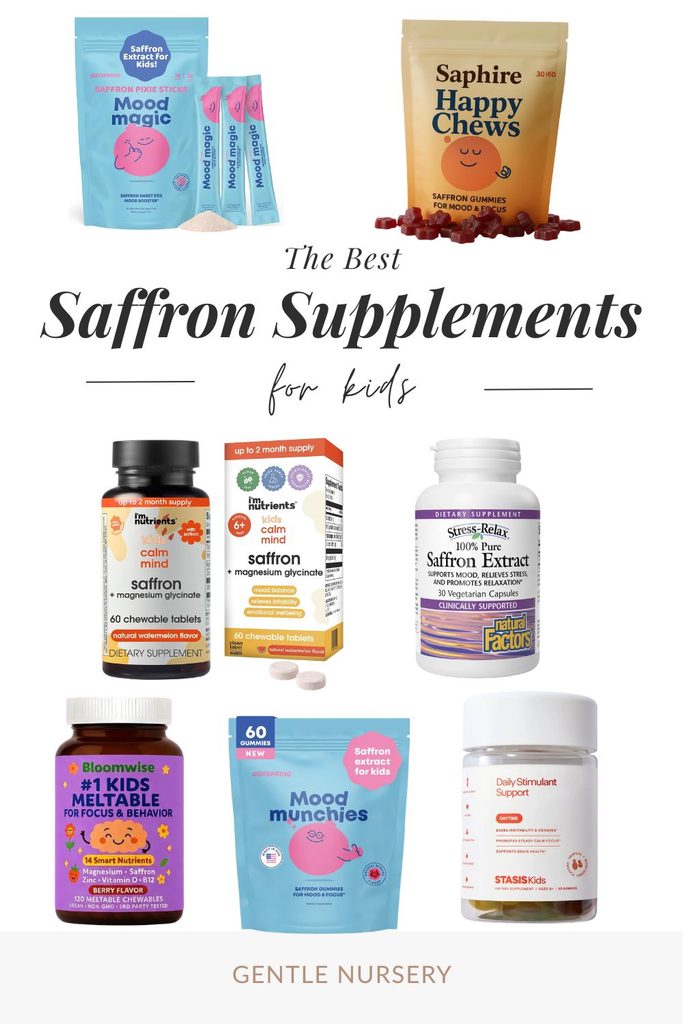
If you want a consistent, measured dose — or you’d like saffron paired with other calming nutrients — these are the options I’d consider. I looked for standardized saffron extracts (the same kind used in the research), clean “other ingredients,” no artificial dyes, and clear age guidance.
Zahler ChildCalm
Best for: kids who need help winding down, with a broader calming formula
This is the one I get asked about most, and I understand why. Each serving (two fruit punch chewables) combines 28 mg of affron saffron extract (the same extract used in the teen anxiety trial) with 200 mg of lemon balm, 100 mg of L-theanine (Suntheanine), 80 mg of magnesium, and a little vitamin B6.
That combination makes sense for a child whose stress shows up as restlessness or trouble settling down, since lemon balm, L-theanine, and magnesium all have their own calming reputations. It’s sweetened with stevia and sorbitol rather than sugar (which I’m not a huge fan of, meh), and contains no artificial dyes. The label suggests one chewable twice a day with food.
The trade-off: it’s a multi-ingredient formula, so if your child reacts well (or doesn’t), it’s harder to know which ingredient made the difference. The label also doesn’t list a minimum age, so ask your pediatrician what’s right for your child. It runs about $35 for a month’s supply.
- 28 mg affron saffron + lemon balm, L-theanine, magnesium, B6
- Fruit punch chewable, no artificial colors or sugar
- Kosher, vegetarian, made in the USA
Shop Zahler ChildCalm on Amazon | Shop Zahler ChildCalm on Fullscript
Triquetra Saffron Kids Organic Drops
Best for: kids who won’t chew tablets, and parents who want the extract from the pediatric ADHD study
These berry-flavored drops use Saffr’Activ, the organic saffron extract studied in the 2022 Nutrients trial, standardized for crocin and safranal. It’s saffron on its own, in an organic glycerin base that’s alcohol-free and sugar-free, and each batch is third-party tested for heavy metals and contaminants.
The label doses by age: about 15 mg for ages 3 to 6, and 30 mg for ages 7 to 17, once a day. Because liquid is easy to adjust and mix into a drink, this is a nice option for picky kids. Just know that the youngest dosing tier goes below the age where research exists, so I’d talk to your pediatrician before using it with a preschooler. It’s about $29.
- Single-ingredient organic Saffr’Activ saffron extract
- Alcohol-free, sugar-free glycerin base
- Third-party tested for heavy metals
Shop Triquetra Saffron Kids Drops
JoySpring Mood Munchies
Best for: younger kids who’ll only take a gummy, at a lower price point
Mood Munchies are berry-flavored gummies for kids 4 and up. They pair saffron with passionflower, GABA, St. John’s Wort, and vitamin D. They’re vegan (made with pectin, not gelatin), have no added sugar or dyes (colored with natural color), and are free of the major allergens, including gluten, dairy, soy, and peanuts. They’re third-party tested and made in the USA. And they’re one of the more affordable picks here.
There are a few things to know before you buy. A two-gummy serving has 8.85 mg of a 10:1 saffron extract, which is less than the 15–30 mg used in the kids’ studies, and it’s a different kind of extract than the standardized ones in the research. That makes it a gentler, lower-dose option, but not a match for the studies. It also has St. John’s Wort, which can interact with many medications, so check with your pediatrician first if your child takes anything. Each serving has 5 grams of sugar alcohol (maltitol), which I truly don’t love because this can cause tummy upset or loose stools in some kids (we try to avoid sugar alcohols in general).
If you’d rather skip the gummies, Joyspring also makes them in pixie sticks.
- Saffron + passionflower, St. John’s Wort, GABA, vitamin D
- Vegan, no added sugar, no dyes, top-allergen free
- Labeled for ages 4+, third-party tested, made in the USA
IM Nutrients Calm Mind Children’s Chewable
Best for: school-age kids, with a clean label and clear age guidance
Calm Mind pairs 15 mg of affron saffron extract per chewable with magnesium, zinc, and the active form of B6 (P5P). It’s labeled for ages 6 and up: one chewable a day for ages 6 to 11, and two a day for ages 12 and up.
I like that it’s sweetened with monk fruit, colored with beet powder, free of artificial colors and the major allergens, and third-party tested for heavy metals. However, it does contain sorbitol, which can upset sensitive tummies as well as maltodextrin and natural flavors; not ideal, but I’m including it on this list because the positives are so good, and due to the absence of tons of other alternatives.
- 15 mg affron saffron + magnesium, zinc, active B6
- Ages 6+, with dosing by age on the label
- Monk fruit sweetened, no artificial colors, third-party tested
Shop IM Nutrients Children’s Chewable
Natural Factors Stress-Relax Pure Saffron Extract
Best for: teens, and the most budget-friendly single-ingredient option
If you have a tween or teen, this is a simple, affordable way to get the same affron extract used in the teen anxiety study. Each vegetarian capsule contains 28 mg of affron and nothing else active — just basic capsule fillers.
It’s labeled for adults and teens over 12, and the dose is one capsule a day. At about $21 for a month, it’s the best value on this list. The obvious trade-off is that it’s a capsule, so it only works for kids who can swallow pills.
- 28 mg affron saffron extract, single ingredient
- Labeled for ages 12+
- Most affordable option on the list
Shop Natural Factors Pure Saffron
Want to Save This Post?
Saphire Saffron Gummies
Best for: kids who will only take a gummy
If your child refuses anything that isn’t a gummy, Saphire is one of the few saffron options made just for that. It uses affron saffron extract, the same extract studied in the teen anxiety trial, along with passionflower, magnesium, L-theanine, GABA, and vitamin D. The gummies are sugar-free, free of artificial dyes, third-party tested for purity, and made in the USA.
The label doses by age: one gummy a day with breakfast for ages 4 to 6, and one to two for ages 7 to 12. My hesitation is that the website doesn’t list how much saffron (or anything else) is in each gummy, so you can’t compare it to the doses used in the research. Older versions of this gummy also contained St. John’s Wort, which can interact with a lot of medications. The current formula says it doesn’t, so if you buy from a third-party seller, check that the bottle in your hand matches. At about $55 for 60 servings it’s on the pricier side. I’d ask the company for the full supplement facts and run them by your pediatrician before starting.
- affron saffron + passionflower, magnesium, L-theanine, GABA, vitamin D
- Sugar-free, no artificial dyes, third-party tested
- Labeled for ages 4 to 12, taken with breakfast
Shop Saphire Saffron Happy Chews
Bloomwise Kids Meltable
Best for: kids who won’t swallow pills or chew gummies, and families who want one all-in-one daily formula
Bloomwise is a berry-flavored “meltable” that dissolves on the tongue, so it’s promoted as an easy option for kids who fight tablets and capsules. However, please note that some parents have said these don’t melt very well; I would only proceed with these if your child is comfortable with chewables. You can also crush it into a smoothie or a spoonful of yogurt.
A serving (four meltables) has 15 mg of saffron extract standardized to 2% safranal, which is the low end of the 15–30 mg range used in the pediatric research. It also has 25 mg of L-theanine, 100 mg of inositol, 50 mg of choline (as alpha-GPC), and 100 mg of taurine. On top of that are a kids’ multivitamin base (D3, C, methyl B12, methylfolate, zinc, magnesium glycinate, vitamin A) and a gut-health blend with 5 billion CFU of probiotics, 500 mg of prebiotic fiber, and a little elderberry.
I like how the label is put together: it’s sweetened with monk fruit or stevia, colored with beet juice, has zero sugar, and is third-party tested. The trade-off is that it’s a lot in one bite and it contains natural flavors and some nondescript ingredients. If your child already takes a multivitamin or probiotic, you’d likely be doubling up, and with this many ingredients it’s hard to know what’s actually helping. Children ages 4 and up take the same four meltables a day, so check with your pediatrician first, especially for a younger or smaller child.
- 15 mg saffron + L-theanine, inositol, choline, taurine, multivitamin, and a probiotic blend
- Berry meltable, zero sugar, monk fruit or stevia, colored with beet juice
- Labeled for ages 4+, third-party tested
Stasis Kids Daytime
Best for: kids who already take a stimulant and struggle with the afternoon crash
If your child is on ADHD medication and you’re dealing with the 3 p.m. meltdowns, cranky evenings, or a hard time winding down at night, Stasis is built for exactly that. It’s meant to be taken alongside a stimulant, not instead of one. Each full serving has 30 mg of Saffr’Activ saffron extract, which is the same extract and daily amount used in the 2022 Nutrients ADHD study. It also has 200 mg of L-theanine, 300 mg of KSM-66 ashwagandha, vitamin D3, methyl B12, and selenium.
I like that Stasis lists every amount on the label, which a lot of kids’ calming supplements don’t. It comes as capsules or gummies, is free of the top nine allergens, and is made in the USA. Each batch is third-party tested for potency, heavy metals, microbes, and pesticides. The label doses by age: one capsule or gummy a day for ages 6 to 9, and two for ages 10 and up. Two things to raise with your child’s doctor first: research on ashwagandha in children is limited, and adding anything to a stimulant routine should be their call. It’s also the priciest pick at $75 one-time, or about $49 a month on subscription.
- 30 mg Saffr’Activ saffron + L-theanine, ashwagandha, D3, B12, selenium
- Designed to take alongside a stimulant, ages 6+
- Capsules or gummies, third-party tested every batch, made in the USA
How to try saffron (without overthinking it)
If you decide to try saffron, a few simple habits make it easier to tell whether it’s actually helping.
Pick one thing at a time. If you start saffron the same week you change bedtime, cut screens, and add magnesium, you won’t know what worked.
Give it a few weeks. Most studies ran six to twelve weeks. Jot down a quick note a few times a week, including meltdowns, homework focus, how long bedtime took, so you’re not relying on memory.
Pair it with the basics. No supplement can outwork a solid bedtime routine, realistic screen time limits, and a calm, connected approach to big feelings and tantrums. Saffron works best as a helper, not the whole plan.
Loop your pediatrician in. Especially if your child is under 5, takes any medication, or you’re considering saffron for ADHD, anxiety, or low mood. A good provider will appreciate that you came with research.
The bottom line on saffron for kids
Saffron is one of the more promising natural options for kids I’ve come across; there’s real research, the doses studied are small, and side effects have been mild. It’s also early science, built on a handful of small studies. So my take is: curious and hopeful, not all-in.
If you’re just dipping a toe in, start with a pinch of good saffron in warm milk. If you want something measured, choose a standardized extract and talk it through with your pediatrician first.
And if you’re in the thick of a hard season with your little one, please hear this: the fact that you’re researching gentle ways to help says so much about the mom you are.
Keep Reading
- The Truth About Melatonin for Kids and Why It’s NOT as Safe as You Think. If bedtime is your biggest struggle, read this before you reach for the melatonin gummies.
- These Tart Cherry Sleep Gummies Are the Natural Bedtime Trick Every Mom Should Try. A simple homemade, melatonin-free gummy that pairs well with a calmer bedtime.
- 12 Respectful Parenting Tips That’ll Transform How You Handle Tantrums. No supplement replaces connection. These are my go-to ways to handle big feelings.
- The 8 Best Probiotics for Babies and Toddlers (That Actually Work). The gut-brain connection is real. Here’s where to start with probiotics for little ones.
- My Favorite Store-Bought Snacks for Kids That Aren’t Full of Junk. Steady blood sugar means steadier moods. These are the snacks I send to school.