
As natural-minded moms, we consider everything that touches our baby’s skin — from the ingredients in their diaper cream to the crib mattress they sleep on. But there’s a lesser-known factor that could be affecting your little one’s comfort, wellbeing, and energy: the vibrational frequency of fabrics.
- Why Fabric Frequency Matters for Babies and Children
- Fabric Frequencies What the Research Shows
- Interesting Takeaways
- What High vs. Low Frequency Fabric Means for Your Baby
- Best High-Vibe Fabrics for Babies and Children
- How to Raise the Frequency of Your Baby’s Wardrobe and Nursery
- Final Thoughts Energetics Matter
- Want help choosing high-vibe essentials for your baby?
I know this may sound a little out there… maybe even “woo woo,” but stay with me. This is backed by both modern research and ancient wisdom, and it just might shift the way you think about clothing and textiles altogether.
Everything carries energy, and that includes the materials we use to clothe and care for our babies. Some fabrics naturally vibrate at a high frequency that supports life and healing. Others (especially synthetic ones) have a frequency of zero.
Hear me out. In this post, we’ll cover:
- Why the vibrational frequency of fabrics matters (especially for babies)
- What the science says about different materials
- The best and worst fabrics to dress your baby in
- Easy ways to raise the frequency of your baby’s wardrobe and nursery
- A handy chart listing fabric frequencies from Heidi Yellen’s study
Why Fabric Frequency Matters for Babies and Children
Everything in the universe is made of energy, including food, your furniture, a mattress, the trees in your backyard, and the clothes you and your family are wearing. Energy vibrates and different substances vibrate at different frequencies (in physics, this is called “resonance”). That vibration affects the way we feel, function, and even heal.
Skip the Research… It's Already Been Done
12+ years of label-reading, testing, and returns — these products earned their place on my Amazon store.
Shop My Amazon PicksFor example, let’s compare two loaves of bread: one store-bought, mass-produced, and machine-wrapped… and the other lovingly homemade in your kitchen. Same ingredients. Different energy. The bread infused with human touch and care vibrates higher, and you can feel the difference.
The same goes for fabrics.
The body has its own frequency, too.
Healthy human tissue vibrates between 62 and 78 MHz (though Heidi Yellen, the researcher behind the fabric study, says it is as high as 100 MHz). Illness is thought to begin when the body’s frequency drops below 58 MHz. And as Health and Bass explains, higher frequency equals higher vitality and consciousness.
Babies, with their developing immune systems and open energy fields, are incredibly sensitive to their environment. That’s why they often react strongly to certain materials, foods, or even the energy in a room. (Does your baby always cry when a certain relative tries to hold them? Riiight?!)
So when we surround them with high-vibration materials, we’re supporting:
- Sleep quality
- Immune regulation
- Mood and fussiness
- Nervous system development
- Skin health
- And overall energetic harmony
On the flip side, low- or zero-frequency fabrics can subtly weigh them down. That footed polyester sleeper may be soft and cuddly, but energetically, it could be draining your baby’s energy, especially when worn for 10+ hours a night.
Fabric Frequencies: What the Research Shows
Dr. Heidi Yellen’s study on vibrational frequencies of fabric used electromagnetic conductivity testing to measure how different textiles resonate with the human energy field.
Here’s what the research found:
| Fabric | Vibrational Frequency (MHz) |
|---|---|
| Linen (Flax) | 5,000 MHz |
| Wool (Organic) | 5,000 MHz |
| Organic Cotton | 100 MHz |
| Hemp | 70–80 MHz |
| Bamboo (Untreated) | ~70 MHz |
| Silk (Natural) | 10 MHz |
| Rayon/Viscose | 0 MHz |
| Polyester | 0 MHz |
| Acrylic | 0 MHz |
| Nylon | 0 MHz |
| Spandex | 0 MHz |
Interesting Takeaways
Yellen’s study says that the human body vibrates at 100 MHz, and fabrics or textiles below this number will put a strain on the body while fabrics that have a higher frequency (like wool and linen) will give energy to the body.
Linen and wool don’t just have a high frequency (5,000 MHz each), they resonate with the human body’s own biofield. They support the body’s energy field and may even help stabilize or elevate it.
But when wool and linen are worn together, their frequencies cancel each other out. This was known even in ancient texts, see Deuteronomy 22:11 and Leviticus 19:19, which prohibited mixing fibers. Whether you take that spiritually or energetically, it’s a good reminder when layering baby bedding or clothing.
Synthetic fabrics like polyester, spandex, rayon, and acrylic have a big, fat measured frequency of zero. That means they neither support nor interact with the body’s energetic system. They’re like empty calories but worse, because they may interfere with the body’s natural rhythm. Some have even gone so far as to call them dead zone fabrics.
What High vs. Low Frequency Fabric Means for Your Baby
So this is useful information, but what exactly does it mean for your family?
High-frequency fabrics resonate with the body’s natural energy, support cellular communication, and are breathable, grounding, and healing. Low- or zero-frequency fabrics don’t resonate with living systems, can block or dull the body’s biofield, and are often linked to overheating, irritation, and static.
Want to Save This Post?
For babies, that can affect:
- How deeply they sleep
- How easily they calm and regulate
- How reactive their skin becomes
- And how well their immune and nervous systems develop
Even though we don’t have baby-specific studies on this (yet), it aligns with everything we already know: Humans are reactive to energy. Children are sensitive. Their systems are pure and easily influenced. The more we can surround them with clean, supportive materials, the better.
Best High-Vibe Fabrics for Babies and Children
Top Choices
- Linen – A powerhouse fabric with the highest measurable frequency. Linen is antibacterial, hypoallergenic, and according to Yellen’s findings, can shield from EMFs. Use for crib sheets, summer clothes, or nursery curtains.
- Organic Wool – Excellent for regulating body temperature in all seasons. Great for diaper covers, mattress pads, and outerwear. Choose non-itchy, baby-safe weaves that are *organic* because traditional wool is typically high in pesticides.
- Organic Cotton – The gold standard for baby clothing. Soft, breathable, affordable, and with a solid vibrational frequency of 100 MHz.
- Hemp – Durable, breathable, antimicrobial. Wonderful for towels, swaddles, and even baby carriers.
Fabrics to Avoid (Whenever Possible)
- Polyester, acrylic, nylon, rayon, spandex – These synthetics are made from petrochemicals and have zero frequency. They may also contribute to overheating, static electricity, and skin irritation.
- Fabric blends – Many baby clothes are labeled “cotton” but blended with synthetic materials. Always read the fine print.
- Flame-retardant treated materials – These often coat pajamas and bedding and are linked to hormone disruption and reduced energetic coherence.
- Untreated Bamboo – While natural bamboo (not bamboo rayon) has decent energetic quality and is soft and breathable, most bamboo clothing and bedding on the market is highly processed and best avoided.
How to Raise the Frequency of Your Baby’s Wardrobe and Nursery
Upgrade the Sleep Environment
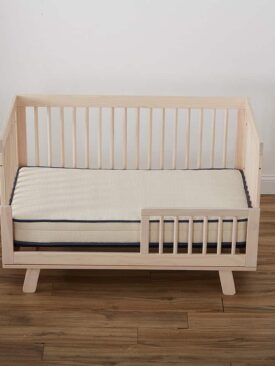
- Crib sheets, swaddles, and sleep sacks are in contact with your baby for 10–14 hours a day.
- Pro tip: Use a wool puddle pad under the fitted sheet for moisture protection and energetic grounding.
Create a Healthy Wardrobe
- Aim for fewer pieces made from higher quality. Choose items that are 100% organic cotton or natural fiber such as linen or wool, depending on the season.
- Look for brands that use GOTS-certified materials, and avoid synthetic fabrics and finishes.
Avoid Fast Fashion and Novelty Items
- Themed onesies and glittery baby gear may be cute but are usually made with low-vibe synthetic blends and heavy dyes.
Incorporate High-Frequency Materials Elsewhere
- Use wool dryer balls instead of dryer sheets.
- Use only clean laundry detergent.
- Swap polyester blackout curtains for linen.
- Choose organic cotton or linen for baby wraps and slings.
Allow sunshine and fresh air into the home.
- Open the windows and curtails daily to allow sunshine and fresh air into the nursery.
- Reduce blue lights and switch to soft lighting in the nursery.
Final Thoughts: Energetics Matter
This might feel like a next-level detail for “extra” moms, but for sensitive, growing babies, the energy of their environment is everything. As always, you don’t need to overhaul everything overnight. But the more high-vibration materials you introduce, even one sheet, one onesie, one blanket at a time, the more you support your child’s calm, radiant energy from the outside in.
✨ Trust your intuition. You’ll often feel the difference.
Want help choosing high-vibe essentials for your baby?
Check out my curated lists of organic, non-toxic, and energetically aligned baby products:
- The Best Organic Baby Crib Sheets + Baby Bedding Brands
- Newborn Layette: What Baby Clothes Do You Need?
- The 15 Best Organic Crib Mattresses for Babies (Flame-Retardant Free)
- Best Non-Toxic Car Seats (Without Flame Retardants)




Leave a Reply