
We tested and analyzed over 30 diaper brands for safety, absorption, and comfort. Here are my top picks for non-toxic diapers!
Babies wear anywhere from 5-10 diapers per day, so you baby will go through thousands of diapers before potty training, with every single one sits against the most sensitive skin on their body for hours at a time. That’s why what diapers are made of matters so much, and why so many parents start their clean-living journey right here, exactly where you are, searching for a cleaner option.
Here’s the honest truth: no disposable diaper is completely non-toxic. Every one contains some plastic and a super-absorbent gel. But some brands are much cleaner than others, and the differences come down to how the pulp is bleached, whether fragrance or lotion is added, and whether the diaper likely contains any PFAS.
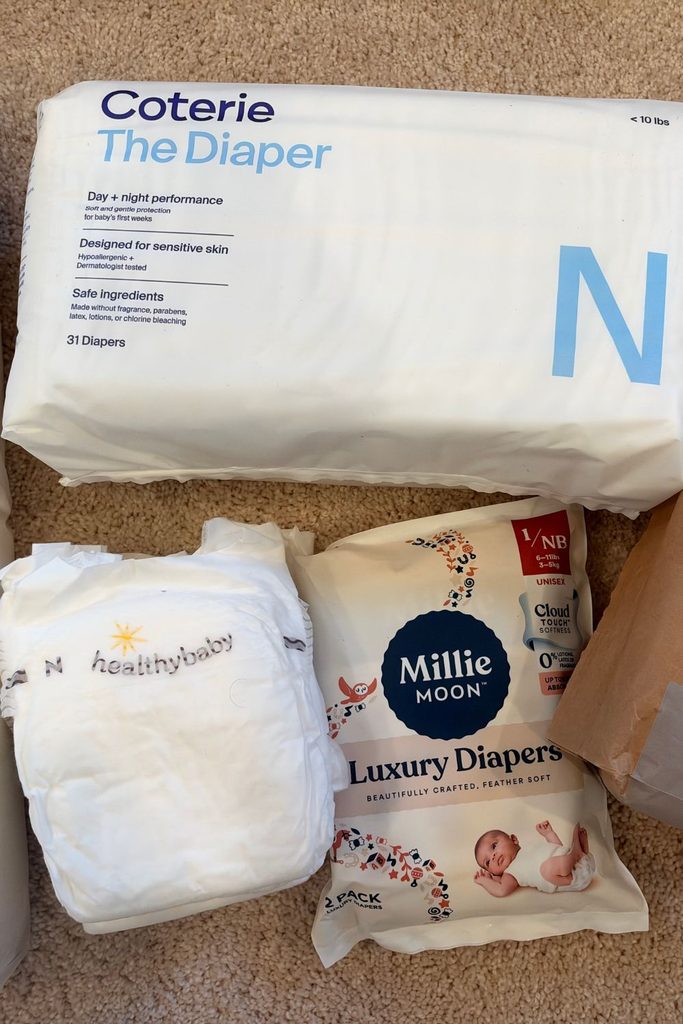
Now with my third baby, I’ve been on a mission to retest these diapers so I can share my exact thoughts with you. I also keep this guide updated as new lab testing and news comes out (like the Millie Moon potential recall or how Honest switched from TCF to ECF). Below you’ll find my observations on each brand’s sizing and fit, a comparison of price and materials, how to choose the right diaper for your baby, and the brands we’ve stopped recommending.
Short on time? I’ve got you.
I’ve already read the labels, so you don’t have to. Everything on my Amazon store is a pick I’d feel good recommending to a friend.
Shop My Amazon PicksIf your baby is dealing with redness right now, my guide to natural diaper rash creams is a good place to start. And then swapping to a cleaner diaper is the next step. In the meantime, the French diapering method is a gentle way to clean without wet wipes.
Quick picks
- Best for newborns: Healthybaby. It’s incredibly soft with a trim fit. Save 15% with code GENTLENURSERY15.
- Best for overnight: Parasol. Parasol diapers are generously sized and highly absorbent.
- Best to grab in store: Freestyle at Target, Kudos at Target, or Pura at Walmart.
- Mama’s favorite: Coterie. It has the best texture of any diaper I’ve tested, excellent absorbency, and the most thorough PFAS test results.
Update – October 2026: we’ve paused our Millie Moon recommendation after more than 600 reports of skin reactions were filed with the CPSC this year. We’ve also updated this guide with Mamavation’s latest PFAS testing, which changed several of our picks.
Diaper price comparison: what each brand really costs
Diapers are one of the biggest baby expenses, so we compared the price of every brand we tested. We took each brand’s price from Target or its own website and worked out the cost per diaper and the cost per month.
All prices are for size 3. Most babies spend more time in size 3 than in any other size, often a year or longer, so it’s the best picture of what you’ll actually spend. The monthly cost assumes about 5-6 diapers a day (168 per month). Prices were checked in November 2026 and may change.
| Brand | Price/Diaper | Price/Month | Type | Link |
|---|---|---|---|---|
| Healthybaby | $0.54 | $90 | TCF | View Details |
| Coterie | $0.62 | $105 | TCF | View Details |
| Freestyle | $0.31 | $52 | NA | View Details |
| Parasol | $0.46 | $77 | TCF | View Details |
| Joonya | $0.60 | $100 | TCF | View Details |
| Pura | $0.40 | $67 | TCF | View Details |
| Kudos | $0.41 | $70 | TCF | View Details |
| Pampers Pure | $0.41 | $70 | TCF | View Details |
| HIRO | $0.73 | $123 | TCF | View Details |
| DYPER | $0.62 | $105 | ECF | View Details |
| Hello Bello | $0.37 | $63 | ECF | View Details |
| Honest Clean Conscious | $0.37 | $63 | ECF | View Details |
| Bioembrace Naty | $0.49 | $82 | ECF | View Details |
| EcOriginals | $0.69 | $117 | ECF | View Details |
| EveryLife | $0.42 | $70 | ECF | View Details |
| TERRA | $0.74 | $123 | ECF | View Details |
| Thrive Market | $0.28 | $47 | ECF | View Details |
Best lowtox disposable diapers
To avoid harmful ingredients commonly found in mainstream diapers, choose disposable diapers that are made more thoughtfully using better materials. These diapers are safer than mainstream diaper brands because they use less harmful chemicals and materials, and we as consumers can deduce that they would provide a reduced risk of irritation and diaper rash, a reduced risk of allergic reaction, and reduced exposure to harsh chemicals and fragrances.
While there is no perfect disposable diaper on the market, this list should provide enough reasons to forgo using mainstream diapers. And the best thing is that the diapers on this list are just as effective and absorbent as mainstream diapers, and sometimes equally cost effective.
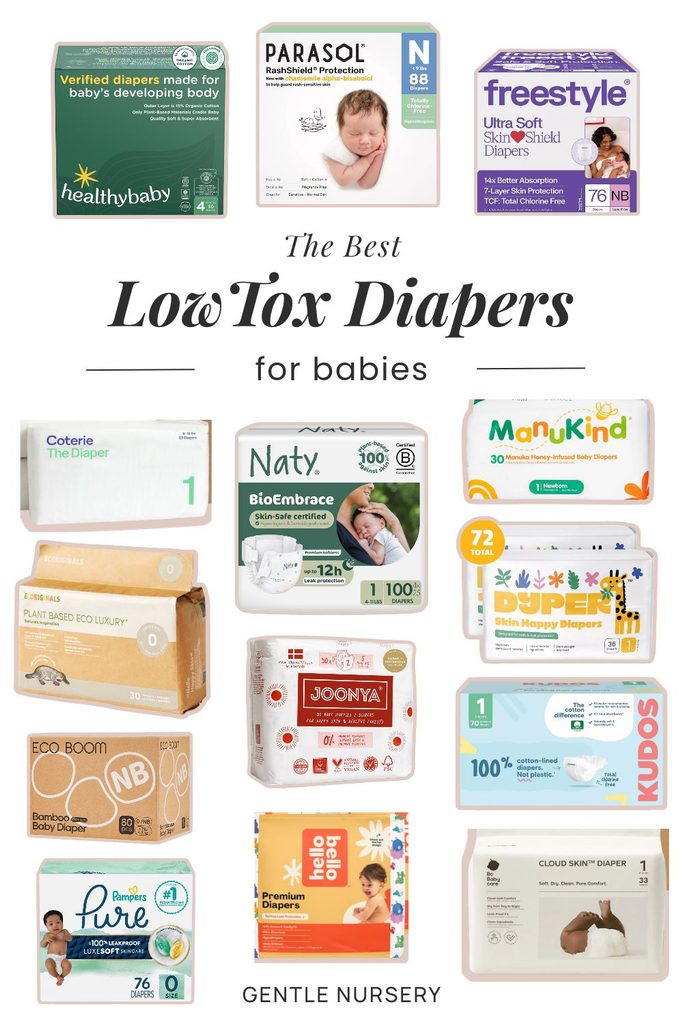
So here are the best non-toxic diapers. These diapers are made with cleaner materials, do not contain any fragrances or lotions, and tested clean in Mamavation’s study on PFAS in diapers. For these important reasons, they are our top recommendations for non-toxic diapers.
1. Healthybaby Diapers
Made with organic cotton and Oeko-Tex certified materials, Healthybaby is my favorite diaper for newborns and my cleanest pick overall.
Featuring a plant-based inner and outer layer, all materials that your baby makes contact with are plant-based and there are no designs on the diaper (the only visible ink is for the label and sizing indicators), which I also love. Healthybaby’s diapers are free of chlorine, dioxins, phthalates, fragrances, and parabens, and they skip the wetness indicator entirely. (However, the. wetness indicator is useful for the first two weeks or so when you are counting diapers.) Their diapers tested well in Mamavation’s study on PFAS in diapers, and they tested clean again when Mamavation retested them in 2026.
HealthyBaby is the brand I chose for my third baby during the newborn stage. When I first tried Healthybaby, the first thing I noticed was how soft and lightweight their diapers are. The other thing I noticed is that it runs a little small for its size number, which is exactly why I think it shines in the newborn months. If you have a bigger or longer baby, you’ll probably want to size up sooner than you would with other brands (I learned this the hard way — by forgetting to size up for a long time). These diapers are also wonderful for babies with sensitive skin, and they’re highly absorbent, even for a lower profile diaper (compared to some other brands).
I also like that these diapers are EWG Verified, because that indicates the company aims to be transparent about their manufacturing process.
- Sizes: Available in sizes 1-6. Approximately 6 lbs. to 37+
- Topsheet: Plant-based
- Where to order Healthybaby diapers:
- Order on Amazon
- Order Healthybaby Diapers directly through the company website (code GENTLENURSERY15)
- Available in-store at Target stores nationwide
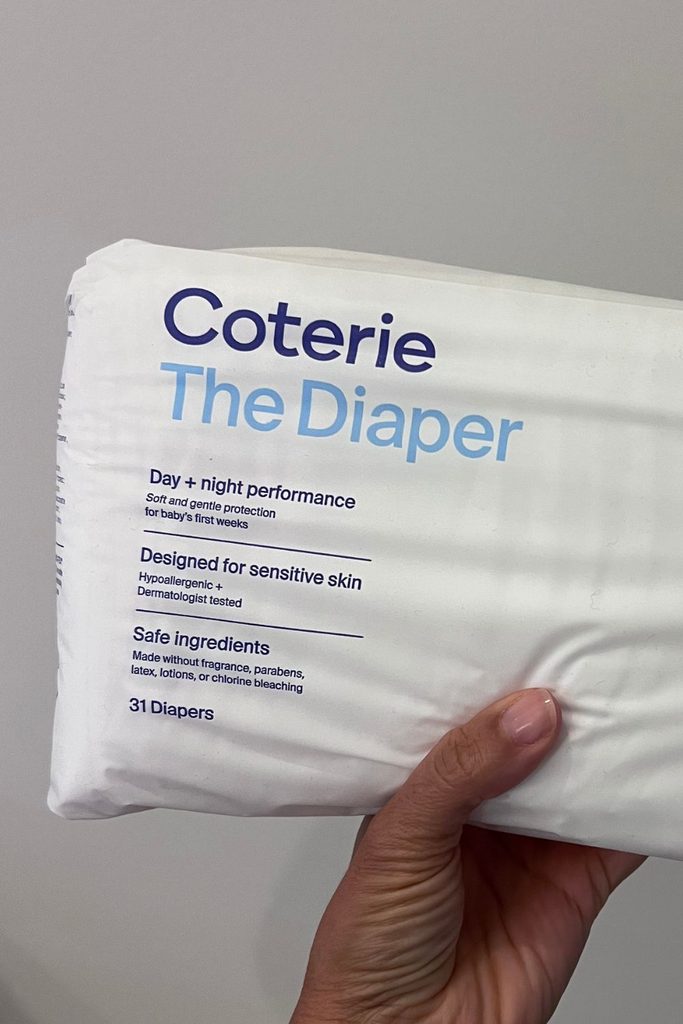
2. Coterie
Coterie is a really wonderful diaper, and it’s one of my top picks for a lowtox diaper, overall. The texture is amazing and it feels so high-end, softer and more cloth-like than any other diaper I’ve tried. Coterie uses a special fabric webbing technique that gives the diapers a luxurious, garment-like feel, and they’re highly absorbent too. When I say highly absorbent in reference to Coterie, I mean extra absorbent. Those two reasons are why I’ve rated Coterie so highly, even when it does have a synthetic topsheet.
One of the hardest things about creating ranking lists like this is finding the balance between clean ingredients and efficacy. So Coterie wins tons of extra points for working so well, and for their commitment to making a healthier diaper.
The diapers are however TCF total chlorine-free and made with wood from sustainable forests, and they’re made without fragrances, phthalates, dyes, and parabens. Coterie is also EWG Verified and publishes a full, layer-by-layer ingredient list, which tells me the company is being transparent with us. It also has the most thorough PFAS results of any brand here: Coterie tested clean in Mamavation’s study, and a follow-up test for 40 individual PFAS down to parts per trillion found none. The one tradeoff is that the topsheet and outer cover are made from polypropylene and polyester, which is common even among the cleanest disposables.
I would love to see Coterie at Target stores, but for now it’s available on the Coterie website and at Whole Foods stores.
- Sizes: Available in sizes N-6. For under 10 lbs to 35+ lbs.
- Topsheet: Synthetic material
- Coterie is available at:
- On the Coterie website for one-time purchase or auto-renew subscription
- At Whole Foods stores nationwide
3. Freestyle Diapers
A pretty unique option for a non-toxic diaper, Freestyle uses a BambooTek core made from bamboo pulp instead of wood fluff pulp. Though they don’t use wood pulp, the rest of the diaper materials are TCF total chlorine-free, and made without fragrance, parabens, phthalates, and latex. These diapers are highly absorbent, soft, and generously sized. Both Freestyle diapers Mamavation tested came back clean for PFAS.
Freestyle is a great diaper. It feels a lot like Coterie and performs really well; I just think Coterie’s texture is a step above. If Coterie isn’t in your budget, Freestyle is an easy swap you can pick up in store. I also love that their diapers don’t have busy designs; just a purple logo and that’s it.
Freestyle diapers are available in sizes 1 through 6 for an 8 to 35+ lb weight range. Since their smallest diaper begins at 8 lbs, they might not be the best fit for a newborn or preemie baby.
- Sizes: Available in sizes 1-6. Approximately 8-38+ lbs.
- Topsheet: Plant-based
- Freestyle Diapers are available at:
- Target
- Walmart
- On the Freestyle website
- Whole Foods and other premium grocers
4. Parasol Diapers
Parasol diapers are free of heavy metals, latex, and chlorine (they are TCF), and they’re made without fragrance, lotion, dyes, parabens, and phthalates. The company uses fluff pulp harvested from sustainably managed forests for absorbency, and it places an emphasis on breathability, using embossed fabrics to make the diapers gentler on your baby’s skin. Parasol uses water-based inks, the diapers are OEKO-TEX STANDARD 100 certified, and they’re super cute, featuring designs from emerging artists in the United States.
Parasol is a great diaper, and it’s very similar to Coterie in feel and performance; the texture just isn’t quite as nice as Coterie’s. Parasol used to be on our “not yet tested” list, but it came back clean in Mamavation’s latest round of testing, so it has moved up to our top tier. Parasol also makes a Pure White line designed for overnight that the brand says holds up to four cups of liquid. Please note that the diapers do contain polypropylene, and the topsheet is infused with alpha-bisabolol, a soothing compound from chamomile. Most babies do fine with it, but if your baby has very reactive skin, keep it in mind.
Parasol comes in sizes 1 (7 to 14 lbs) through 35+ lbs.
5. Joonya Diapers
Joonya diapers are another brand coming out of Australia. While we’ve recommended their baby wipes for some time, their diapers have now earned a spot in our top tier. Joonya’s diapers are TCF chlorine-free, and made without parabens, latex, phthalates, perfumes, and heavy metals or toxic dyes. They used to be on our “not yet tested” list, but Mamavation has since tested them and found no indications of PFAS.
Joonya’s diapers are made in Denmark and are known for their ultra-slim fit, which makes them a nice choice for smaller babies. They come in sizes XS (4 to 9 lbs) through XL, plus pull-up pants, and you can find them on Amazon and at Target. I haven’t personally tried these (yet!) so I can’t fully comment on their absorption. However, I am working my way through all of the diaper brands I’ve included on this list. I’ll update as soon as we get to Joonya!
6. HIRO Diapers
HIRO is a newer diaper brand made in Canada, with a softwood fluff pulp core processed totally chlorine-free (TCF) and a backsheet made from U.S.-grown cotton and recycled polyester. The diapers are made without fragrance, lotion, dyes, latex, or parabens, and HIRO skips the blue wetness indicator. The topsheet that touches your baby’s skin is polypropylene, though the company says it’s exploring plant-based alternatives.
What makes HIRO unique is what happens after the diaper comes off. Every delivery includes a pouch of food-grade mycelium (mushroom roots) that you tuck into the used diaper; once it’s wet, the company says it releases enzymes that help break the plastic down in a landfill. The pouch never touches your baby. HIRO is sold by subscription on its website in sizes Newborn through 5, and it works out to about 73 cents per diaper in Size 3.
- Shop through HIRO directly
7. Kudos Diapers
Made with a cotton topsheet sourced from cotton farms in the United States, Kudos Diapers are engineered to prevent synthetic materials from making direct contact with your baby’s skin. With super soft materials and two absorbent layers, Kudos is a great choice for your baby’s non-toxic diaper. I really liked their diapers and found them to be very soft.
One heads up though: Kudos did not pass the Mamavation study testing (two size 4 diapers failed, while one size 5 diaper tested clean). But the brand later conducted PFAS testing independently and shared negative test results. Please note that these are not necessarily tested at the same lab or with the same detection limits, and since I don’t have all of these details, I can’t reach a conclusion.
They’re available in sizes 1-6 for a 7-30+ lb. weight range. The diapers run a little small compared to other brands (FYI) and come in two cute prints as well as a plain white version.
- Sizes: Available in sizes 1-6. Approximately 7-30+ lbs. Runs small.
- Topsheet: Cotton
- Kudos Diapers are available:
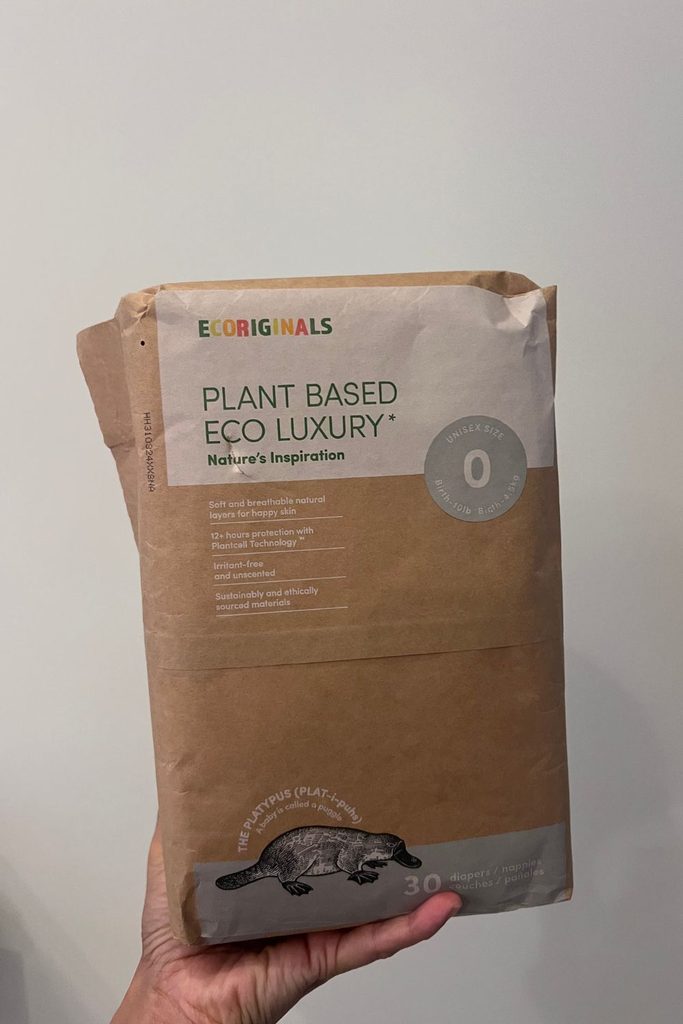
8. Ecoriginals Plant-Based Diapers
EcOriginals, originally an Australian brand, makes a high-quality non-toxic disposable diaper. The only materials your baby will make contact with are the cotton topsheet, cotton leg cuffs, and non-GMO cornstarch. EcOriginals is focused on being a sustainable diaper brand, and even their packaging is made from paper and is recyclable.
The diapers themselves are free from AZO dyes (love this), formaldehyde, and heavy metals, and they’re absorbent and more than 90% biodegradable. The brand describes them as chlorine-free and independently tested free of PFAS, and they tested clean in Mamavation’s study too, though Mamavation lists the pulp as ECF. EcOriginals is one of the pricier options, at about 87 cents per diaper in Size 3 when you buy a 6-pack.
- Topsheet: plant-based
- EcOriginals are available through Amazon
9. Pura Diapers
Pura is a UK brand that recently launched in the U.S. at Walmart. Its diapers are enhanced with organic cotton, use a plant-based waterproof layer, and are made without fragrance, chlorine bleaching, lotion, parabens, latex, or phthalates. They carry the EU Ecolabel and Allergy UK certification, Pura is a certified B Corp, and the diapers showed no indications of PFAS in Mamavation’s testing.
What I like about Pura is that you get a European-standard diaper without a subscription. The diapers are made in the EU, and Walmart carries sizes 1 through 7, so it’s also a good option for bigger toddlers who have outgrown other brands’ size ranges. Since Pura is newer to the U.S., stock can be spotty, and there’s no newborn size at Walmart yet.
10. Honest Clean Conscious Diapers
Though I don’t use many Honest Company baby products, their diapers are well-made and absorbent. However, their diapers have gone through many changes and have been reformulated to be less plant-based and more petroleum-based over the years. Honest Company diapers were reformulated in 2018, and now the inner layer is made from polyethylene and polypropylene, which is unfortunate since they previously used a plant-based PLA inner layer. So, please note that your baby will come in direct contact with these plastic-based materials.
In November 2023, Honest Company switched from TCF to ECF processing. Overall, Honest Diapers are still a good and reliable choice, and they tested clean in Mamavation’s study, but I wish they had kept their TCF pulp in place. You can find them on Amazon, at Target and Walmart, and on Honest’s website.
- Topsheet: synthetic
- Honest Company Diapers are available at:
11. Eco by Naty Diapers
Naty diapers are also a great pick when you’re looking for natural diapers because they contain no phthalates, organotins (MBT, DBT, TBT), allergens, carcinogens, heavy metals, chlorine, formaldehyde, colophonium, dyes, PVC, GMOs, dioxins, or any substances known to be harmful. They were TCF but are now ECF, though the company has indicated there are no dioxins to worry about. Naty diapers also don’t have any fragrances or perfumes, so you don’t need to worry about skin reactions caused by questionable fragrance ingredients, and they tested clean in Mamavation’s study.
Eco by Naty Diapers are certified by the Swedish Society for Nature Conservancy and are made from more than 60% natural biodegradable materials. Please note that they are made using cornstarch, which can be a potential allergen to the most sensitive of babies. Developed in Sweden and made in Turkey, Naty Diapers are known for being absorbent and having a great fit.
Naty has also relaunched its diaper as BioEmbrace and shortened its name from “Eco by Naty” to just “Naty.” The new version uses sugarcane-based materials on every layer that touches your baby’s skin, is OEKO-TEX STANDARD 100 certified, and is certified free of PFAS, parabens, phthalates, and chlorine. You can find Naty on Amazon and at Walmart.
12. EcoBoom
If you prefer bamboo diapers, ECO BOOM is another great choice. The topsheet and bottomsheet are made from bamboo viscose and the pulp is TCF total chlorine-free. These diapers are pretty similar to DYPER, and they also have a wetness indicator at the front. They are very absorbent and great for overnight, and they tested clean in Mamavation’s PFAS study.
ECO BOOM comes in sizes 0 through 5, for babies under 7 lbs to 26+ lbs, and they also have a size for preemies.
- Sizes: 0-5 for under 7 lbs. to 26+ lbs.
- Topsheet: Plant-based
- EcoBoom is available through:
13. Dyper
DYPER is made from viscose fibers sourced from bamboo. They don’t have any designs or patterns, so you don’t have to worry about any questionable dyes being used. The diapers (dypers?) are soft and absorbent, and many parents are falling in love with this brand because of its affordability. The diapers contain no phthalates, latex, alcohol, perfumes, lotions, TBT, or PVC.
Perhaps the best thing about DYPER is that the entire diaper is OEKO-TEX certified. Unlike other brands that indicate they are OEKO-TEX certified but merely use certified materials, DYPER has a full certification for the final product. DYPER tested clean in Mamavation’s study, but it lands on our Better list because its pulp is ECF rather than TCF.
To order DYPER, you sign up for a monthly diaper subscription. The nice thing about this is that you can set it and forget it, and DYPER will adjust your subscription using predictive modeling to estimate the size and quantity of diapers your baby needs based on their age. If they get it wrong or you simply need more diapers, they’ll send you a replacement, and it can arrive in as little as a few hours. You can also manage your subscription through DYPER’s mobile apps, and if you happen to be on vacation, DYPER can send an extra shipment to your hotel or Airbnb.
You can also manage your subscription through Dyper’s mobile apps. If you happen to be on vacation, for example, Dyper can also send you an extra shipment to your hotel or Airbnb.
- Topsheet: Plant-based
- Dyper is available through:
- Amazon
- Dyper’s website direct (subscription or one-time orders)
14. Hello Bello Diapers
Hello Bello tested clean for fluorine in Mamavation’s study. These diapers have been a longtime favorite of parents, especially because of their affordability. They’re ECF but contain a plant-based topsheet, making them a better choice for your baby’s diaper than many mainstream brands. Hello Bello costs about 47 cents per diaper in Size 3 at Walmart, and you can also find it on Amazon and on the company’s website.
- Topsheet: plant-based
- Hello Bello diapers are available at
15. Pampers Pure
Pampers Pure is the company’s venture into non-toxic diapers. And what’s great about this line is that they are easily accessible at stores like Walmart and Target, and they are much cleaner than their traditional diapers. Their diapers are TCF total chlorine-free and fragrance-free, and are made with a mix of cotton, polypropylene, and plant-based materials, and they tested clean in Mamavation’s study.
The main reason I didn’t rank this brand higher was because the company doesn’t disclose all of their materials, claiming they are proprietary. So while these may be good in a pinch, I wouldn’t enthusiastically recommend them for everyday use. Pampers Pure costs about 45 cents per diaper in Size 3 at Target, and you can also find it on Amazon and at Walmart.
16. EveryLife Diapers
EveryLife is OEKO-TEX STANDARD 100 certified, and the brand says its diapers are made without fragrance, dyes, lotions, latex, parabens, or phthalates. It also states that the diapers contain no PFAS, which matches Mamavation’s results for its training pants. The core uses ECF pulp rather than TCF, which is why it sits on our Better list.
EveryLife is a solid middle-ground pick if you want a cleaner diaper delivered to your door without paying premium prices. It comes in sizes Newborn (up to 10 lbs) through 6 (35+ lbs).
- Topsheet: synthetic
- Everylife diapers are available through their website
17. TERRA Plant-Based Diapers
TERRA says its diapers are 85% plant-based, with a bamboo-fiber backsheet and leg cuffs, a corn-starch water-resistant layer, FSC-certified wood pulp, and a plant-based wetness indicator. They’re rated “Excellent” by Dermatest and made without chlorine, fragrance, latex, parabens, or phthalates. TERRA’s diaper pants showed no indications of PFAS in Mamavation’s testing, though the tab diapers weren’t tested, and TERRA doesn’t say whether its pulp is TCF or ECF.
TERRA is a nice option if you want more plant-based materials touching your baby. It comes in sizes 1 (up to 11 lbs) through 6 (35+ lbs), and you can pick it up at Whole Foods.
- Terra is availabe through:
- Amazon
- WholeFoods
18. Thrive Market Diapers
Thrive is an online market that sells products made with renewable and sustainable raw materials. Their diapers are no different, given the company’s commitment to using natural materials and avoid petroleum-based materials whenever possible. Besides being better for the environment and safer for your baby, these diapers are also known to be super absorbent so it’s a win-win all around!
A few things to know before choosing this brand: the newborn size can run pretty small (so I wouldn’t stock up in advance), and these diapers aren’t as soft as some of the other diapers on this list. They also contain a “plant-based” absorbent core made from GMO corn that I’m not 100% crazy about. Otherwise, they are a great pick for a safer diaper on a budget.
- Topsheet: synthetic
- Thrive diapers are only available with a Thrive Market account.
Let’s break down what’s in a diaper
Disposable diapers are pretty complex in their design. They require multiple layers and materials to absorb liquids and keep your baby comfortable between diaper changes. Diapers can be made from various materials, many synthetic, each chosen for specific properties like absorbency, comfort, and durability.
Here’s a breakdown of typical components found in most diapers:
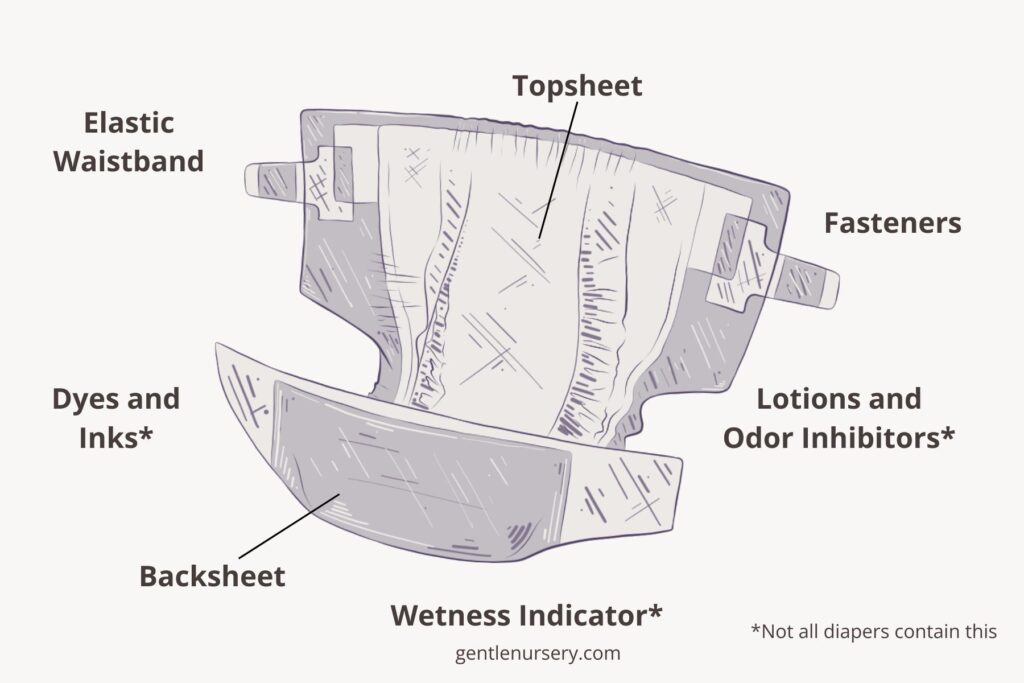
- Topsheet (Inner Lining): Made from non-woven fabric, this layer makes direct contact with the baby’s skin and is designed to allow fluid to pass through while feeling dry. Topsheets can be made from cotton, polyester, bamboo-nylon, or a polyester-rayon blend.
- Absorbent Core: The core is crucial for absorbing and retaining liquids. In disposable diapers, it usually consists of Super Absorbent Polymer (SAP), often sodium polyacrylate, which can hold many times its weight in liquid. The core might also contain fluff pulp, made from wood.
- Backsheet (Outer Layer): The backsheet is typically made of a waterproof material like polyethylene film or a cloth-like waterproof exterior. It’s designed to prevent liquids from leaking out of the diaper. Some brands have logos or designs on the outside of their diapers, while others are just plain white.
- Elastic Elements: Elastics around the waist and leg openings provide a snug, comfortable fit. These can be made from synthetic rubber or spandex.
- Fastening System: Traditional disposable diapers use strips of a hook-and-loop or adhesive material similar to Velcro for closures.
- Wetness Indicator: Many disposable diapers include a wetness indicator, usually a strip that changes color when wet, made from a dye that reacts to moisture. These can contain ingredients of concern.
- Dyes, Fragrances, and Lotions: Some diapers contain dyes or inks used for patterns and colors. Some also contain lotions or aloe vera linings to help protect the baby’s skin. And some diapers contain fragrances, lotions, or odor inhibitors that can also be problematic and unhealthy.
It’s important to note that materials can vary significantly from one diaper brand to another, and that’s a large part of what goes into choosing a non-toxic disposable diaper.
But, let’s address the elephant in the room.
Diaper manufacturers are not currently required to disclose all of their ingredients (though that is changing in 2029) and some companies won’t even tell you what is in their diapers. That’s a BIG red flag 🚩 that tells me that some diaper brands may contain even more harmful ingredients than we realize.
The good thing is that more and more companies are starting to voluntarily disclose their ingredients, but not all are doing this. Even when they do, some brands are being deceptive or just not telling us the full story. Please understand this makes it difficult for any consumer to truly make informed choices.
So, what makes a diaper toxic?
Diapers can be toxic and unhealthy in a number of ways, from the fabrics and materials used in making the diaper, to where the diaper itself is manufactured. Here are some things to look out for:
❌ PFAS Found in Diapers
Do we need to be concerned about perfluorinated chemicals in diapers? Yes, sadly.
PFAS are forever chemicals that are associated with a number of health issues, and the biggest issue is that they are persistent. This means that they build up in the body and are difficult to expel. They are also found in the environment.
Mamavation conducted a consumer study on PFAS in cloth and disposable diapers, and the results were shocking.
- 23% of products tested had indications of PFAS.
- 17% of disposable diapers tested had indications of PFAS.
- 30% of reusable cloth diapers & accessories had indications of PFAS.
And it wasn’t just a matter of mainstream vs. modern brands. This issue affects diaper brands across the board, as Mamavation tested 65 products from a mix of brands (healthy and mainstream). In many instances, the problem likely stems from a manufacturing issue, not a material choice.
But the bottom line is: avoid any diaper brand that tested high for indications of PFAS, and choose a safer diaper that tested clean.
❌ Chlorine, Derivatives, and Dioxins
Disposable diapers were traditionally made using wood pulp bleached with elemental chlorine. This process is toxic and results in a byproduct called dioxins.
Dioxins are a class of highly toxic chemicals that accumulate in your body and can wreak havoc on the immune system. Dioxins are highly carcinogenic and they are also known to cause allergic skin reactions and skin irritations.
Thanks to growing concerns over the byproducts of chlorine bleaching, government regulations in the 1990s eliminated wood pulp bleached with elemental chlorine. As a result, two safer bleaching methods have become the standard in wood pulp bleaching used in disposable diapers:
- ECF: elemental chlorine-free pulp. [Not recommended] You’ll now find diapers that are marketed using ECF pulp, which means that elemental chlorine is not used. However, the pulp is bleached with chlorine dioxide, which is a chlorine derivative and itself is a hazardous substance. This process reduces dioxins, but it believed that it does not fully eliminate them and simply that some testing mechanisms may not be able to detect their presence. Since the data is inconclusive, and chlorine dioxide is still a derivative of chlorine, I prefer to avoid ECF when possible. This process is safer than bleaching with elemental chlorine, but I do not recommend elemental chlorine-free diapers if and when there are better alternatives available.
- TCF: total chlorine-free pulp. TCF is a bleaching process that does not use chlorine or chlorine derivatives. It is a much safer process because it uses oxygen, peroxide, or ozone-based bleaching systems. These methods are safer than using chlorine because they do not generate dioxins. This is the safest bleaching method you’ll find being used in diapers at this time. Always look for TCF (total chlorine-free) pulp when possible.
More and more brands are switching from TCF to ECF such as Millie Moon and Honest Company. Whenever reasonable, try to use a brand of diaper that is TCF. We don’t fully know the implications of ECF at this time.
NOTE: Don’t fall for technicalities or greenwashing. It is NOT enough for a company to call their diapers “chlorine-free” or “elemental chlorine-free” because they may be claiming that it does not contain elemental chlorine while it does contain chlorine dioxide. Always look for pulp that is explicitly TCF total chlorine-free.
❌ Fragrances, Lotions, and Phthalates
Fragrances, odor inhibitors, and lotions are all used in many disposable diaper brands.
Anytime a company lists “fragrance” in their list of ingredients, it means they are not disclosing the full list of ingredients in their fragrance due to a loophole in the law that allows for the protection of trade secrets.
Synthetic fragrances may contain phthalates, which are known endocrine disruptors. Using products that contain a nondescript “fragrance” or even an odor inhibitor puts your baby’s skin in direct contact with these chemicals and puts them at risk of rashes, skin irritation, allergic reactions, and other health hazards.
⁉️ Sodium Polyacrylate: Can It Be Avoided?
Most disposable diapers contain sodium polyacrylate (SAP) because this material makes diapers absorbent. If you have ever had a diaper break apart after a leak, you may have noticed sodium polyacrylate as small gel-like crystals on your baby’s skin. (By the way, you should discontinue using any diapers that leak gels/crystals onto your baby’s skin — and ask the company for a refund.)
Sodium polyacrylate is believed to cause skin irritations and may or may not be a health hazard. It is the same chemical found in tampons that was linked to Toxic Shock Syndrome in women in the 1980s, though this may have been because women left the tampons in too long and created a breeding ground for bacteria.
Sadly, however, I have found that most disposable diapers contain some form of SAP, including eco-friendly and non-toxic diapers. Many also contain layers made with plastic that will also come in contact with your baby’s skin.
There is only one diaper brand that I know of that uses a bamboo-based core instead of SAP, and you can also use cloth diapers if you are looking avoid sodium polyacrylate.
❌ Other Chemicals to Avoid
Here’s a shortlist of other chemicals of concern commonly found in diapers:
Tributyltin. Another chemical found in many disposable diapers is tributyltin or TBT. This chemical is known to be extremely harmful to water life and may also cause skin problems in humans.
VOCs. Disposable diapers commonly contain volatile organic compounds (VOCs), which are chemicals that have a high vapor pressure at room temperature. The VOCs commonly found in disposable diapers include such chemicals as toluene, ethylbenzene, and xylene. These chemicals can evaporate and cause impaired immune function and damage to the liver, kidneys, respiratory system, and lungs.
Investing in non-toxic diapers is one of the most important decisions you can make for your baby. Because of such prolonged use, the risk of exposure to toxic substances from traditional diapers is high and simply not worth the cost savings that you’d get from using mainstream brands.




Hi there, I noticed that you recommend the Bambo Nature Diapers, and state they were not tested in the Mamavation research. In the Mamavation research she mentions the following:
“Bamboo Nature Dream Diapers — inside results 18 ppm organic fluorine, outside results 22 ppm organic fluorine, [updated product 4/29/24] “, and ranks these diapers within the “Not our favorite disposable diapers” section because they do contain PFAS. Are the “Bambo Nature” in your list not the same as her “Bamboo Nature Dream” diapers? Just want to be sure, since I can find the Bambo Nature Diapers in my country and am very limited within my choices.
Many thanks!
I love dyper. But sometime in the last 6 months they changed something. It still works well but the feel and looks were off. Then this summer they added print. Now they smell. How recently were they tested?
Hi Yasmine! I have learned so much from your page so far. I wanted to ask if you know anything about the Kirkland diapers from Costco? They are made with plant based materials and advertise as made without natural rubber latex, elemental chlorine, fragrance, and lotion but I know a lot of other ingredients can be hidden in there and are not safe. If you could let me know if you have any information on this specific brand? Thanks!
Love your site!!! Want to let you know Ecos by Naty has been having A LOT of manufacturing issues. We just couldn’t take it anymore and switched to a different brand. I’ve contacted them and they already know of their quality issues. They try to work with you and provide you replacement diapers. However, we were still seeing issues. Love their diapers, it’s unfortunate.
We have seen a lot of that across many brands and product types. Thanks for your note, Jenn!
Hi, Just wondering if there was a reason Mummi wasn’t on this list?
Hi Lillian, are they available in the US?
How “green” are Seventh Generation? I know that their other products aren’t as green as they claim just wondering if that is the same for the diapers.
In your post, there is an affiliate to BabieB Bamboo diaper instead of the Naty (Buy Now). Do you recommend that brand?
Hi Ana, that’s incorrect. Thanks for letting me know. I’ll have that updated!
Thank you! Do you recommend 7th generation diapers and wipes? or Earth’s Best TenderCare Chlorine-Free Diapers, Fragrance Free ?
Have you looked into the Pampers Pure Protection diapers? These seem to be new from Pampers and be totally chlorine free per their website.
They looked great but I didn’t list them because they wouldn’t disclose an ingredient to me (the odor absorbing mineral), citing that it was proprietary. My sense is that they’re probably safe to use but I couldn’t say 100% without knowing all of the materials they use.
Which of these come in a pull-up style for potty training?
Honest and Bambo have them!